
Riham Alhourani
Lebanon
Synthesis and biological activity of triphenyl substituted imidazoles
Riham Alhourani 1, AliJaber 1,2,Ghassan Ibrahim 1,Edmond Shebli 1,3
1. Recherche et Développement des Médicaments et des Produits Naturels (RDMPN), Faculty of Pharmacy, Lebanese University, Hadath, Lebanon.
2. Department of Natural Sciences, School of Arts and Sciences, Lebanese American University, Beirut, Lebanon.
3. Al-Kut University College, Department of Pharmacy, Wasit Governorate, Iraq.
Abstract
Background
Imidazole-based heterocyclic compounds represent an emerging class of multifunctional scaffolds with broad pharmacological relevance. However, synthetic access to structurally diverse analogues remains limited. Increasing chemical diversity within this framework is essential to enhance structure activity relationships and uncover new biological properties. The Debus–Radziszewski multicomponent reaction represents a powerful strategy for rapid heterocyclic assembly. This project sought to strategically adapt and optimize this classical transformation to expand the chemical diversity of Triphenyl-imidazole scaffolds and to establish their structural integrity and preliminary biological relevance.
Methods
A tailored Debus–Radziszewski protocol was employed with systematic modulation of aromatic aldehydes, reaction stoichiometry, and catalytic condensation conditions to optimize conversion and direct product selectivity. Reaction workup and purification using column chromatography and recrystallization were refined to improve isolated yields. Structural elucidation was performed using FT-IR, UV–Vis, and ¹H NMR spectroscopy, augmented by XRD to confirm ring formation N–H imidazole functionality, and the anticipated substitution architecture. Thermal analysis was additionally performed to evaluate the thermal stability and decomposition profiles of the synthesized derivatives providing further insight into their physicochemical robustness. Biological profiling was conducted using standardized in vitro assays to obtain an initial assessment of the compounds’ functional activity.
Results
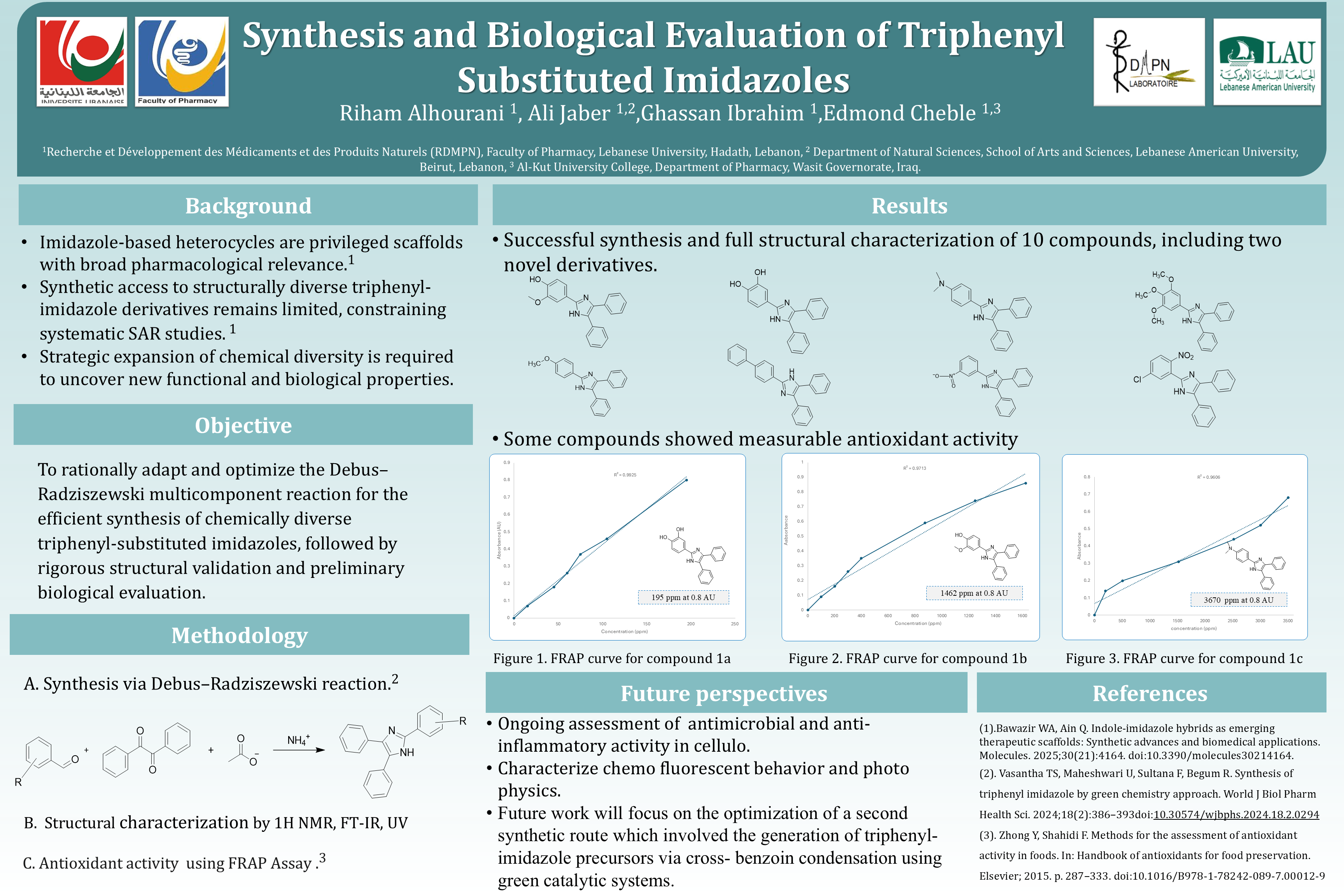
This protocol delivered a streamlined and dependable route for constructing highly substituted triphenyl-imidazoles, overcoming the inefficiencies typically associated with this scaffold. Ten Triphenyl-imidazole derivatives were successfully synthesized, including three structures proposed as novel. The refined conditions consistently afforded clean product profiles with markedly improved selectivity and reproducibility. Comprehensive spectroscopic, thermal and crystallographic analyses unambiguously confirmed the successful assembly of all eleven derivatives, including three structurally distinct compounds proposed as previously unreported. Importantly, early biological assessment revealed clear structure-dependent trends, indicating that subtle electronic and steric modifications across the aryl framework exert measurable influence on molecular behavior.
Conclusions
This study successfully explored the design, synthesis, and preliminary biological evaluation of some triphenyl-substituted imidazole derivatives, aiming to broaden the chemical diversity. Ongoing work is focusing on optimizing a second pioneering synthetic route, to achieve higher efficiency and reproducibility under green chemistry paradigms as well as testing them for more biological activities.
Leave A Comment